The Pythagorean Theorem
Pythagoras studied right triangles, and the relationships between the legs and the hypotenuse of a right triangle, before deriving his theory.
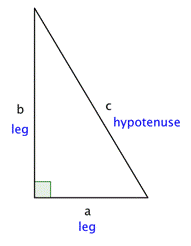
The Pythagorean Theorem
|
If a and b are the lengths of the legs of a right triangle and c is the length of the hypotenuse, then the sum of the squares of the lengths of the legs is equal to the square of the length of the hypotenuse.
This relationship is represented by the formula:
 |
In the box above, you may have noticed the word “square,” as well as the small 2s to the top right of the letters in . To square a number means to multiply it by itself. So, for example, to square the number 5 you multiply 5 • 5, and to square the number 12, you multiply 12 • 12. Some common squares are shown in the table
. To square a number means to multiply it by itself. So, for example, to square the number 5 you multiply 5 • 5, and to square the number 12, you multiply 12 • 12. Some common squares are shown in the table 
No comments:
Post a Comment