Two ways to get 45 from the single digits.......1 - 9...or 0 - 9........sum to 45...................two of them........................it may seem nitpicky.......but there is a difference........like the F. sequence.........can be seen to start from 0 or 1........0 or 1................dead center...........1/2........like the critical line.....
1 - 9..........1 + 9 = 10............2 + 8 = 10...............3 + 7 = 10............4 + 6 = 10............and a 5................28...........the sum of the 1st 5 primes..............37.........the sum of the 1st 5......non primes.......both connect single digits to double digits............28 in e twice.......37.............2.71 8281828................2 + 7 + 1 = 10.......................8 + 2 + 8 + 1 + 8 + 2 + 8 = 37............3 numbers........then 7 numbers.......................different ways to divide e up.........set theory.............................3 + 7 = 10............2 +8 = 10............adding single digits to double digits...........1st 5.........like 1/5..........from the harmonic series.....1/5 = 0.20..........the 1st 20 numbers.........................contain a pattern primes..........4 and then 4.......1828........1828..........two 4's..................................1/4 and 1/5...............from the harmonic series.....1/4 = 0.25.........1/5 = 0.20........0.25 + 0.20 = 0.45............fractal patterns...........
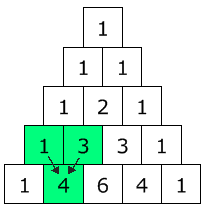 One of the most interesting Number Patterns is Pascal's Triangle (named after Blaise Pascal, a famous French Mathematician and Philosopher).
To build the triangle, start with "1" at the top, then continue placing numbers below it in a triangular pattern.
Each number is the numbers directly above it added together.
(Here I have highlighted that 1+3 = 4)
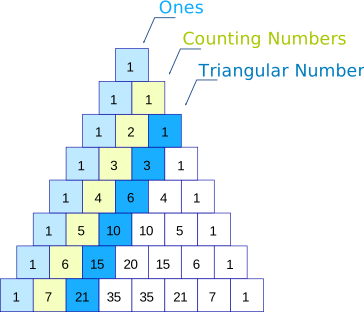
1 - 9..........1 + 9 = 10............2 + 8 = 10...............3 + 7 = 10............4 + 6 = 10............and a 5................28...........the sum of the 1st 5 primes..............37.........the sum of the 1st 5......non primes.......both connect single digits to double digits............28 in e twice.......37.............2.71 8281828................2 + 7 + 1 = 10.......................8 + 2 + 8 + 1 + 8 + 2 + 8 = 37............3 numbers........then 7 numbers.......................different ways to divide e up.........set theory.............................3 + 7 = 10............2 +8 = 10............adding single digits to double digits...........1st 5.........like 1/5..........from the harmonic series.....1/5 = 0.20..........the 1st 20 numbers.........................contain a pattern primes..........4 and then 4.......1828........1828..........two 4's..................................1/4 and 1/5...............from the harmonic series.....1/4 = 0.25.........1/5 = 0.20........0.25 + 0.20 = 0.45............fractal patterns...........
Pascal's Triangle
To build the triangle, start with "1" at the top, then continue placing numbers below it in a triangular pattern.
Each number is the numbers directly above it added together.
(Here I have highlighted that 1+3 = 4)
Patterns Within the Triangle


Comments
Post a Comment