30 million light years away........to a special Queen and her daughter.......her majesty, Queen Nesera and her majesty........Princess Jessenia.........who i danced with when i was 6........Princess Jesenia was 6 as well......Queen Nesera said one day she might be back...like 47 years later she did when i was still at New York ave shelter........the Queen said Jessenia is now 17, and i was 53 years.........like 10 months ago, when she came back..
My Pop introduced me to the advisor......said he wanted me to meet someone....Dave and our Nana must have been out shopping...........in the Chinese house which was at 902 Bayard, 19971...
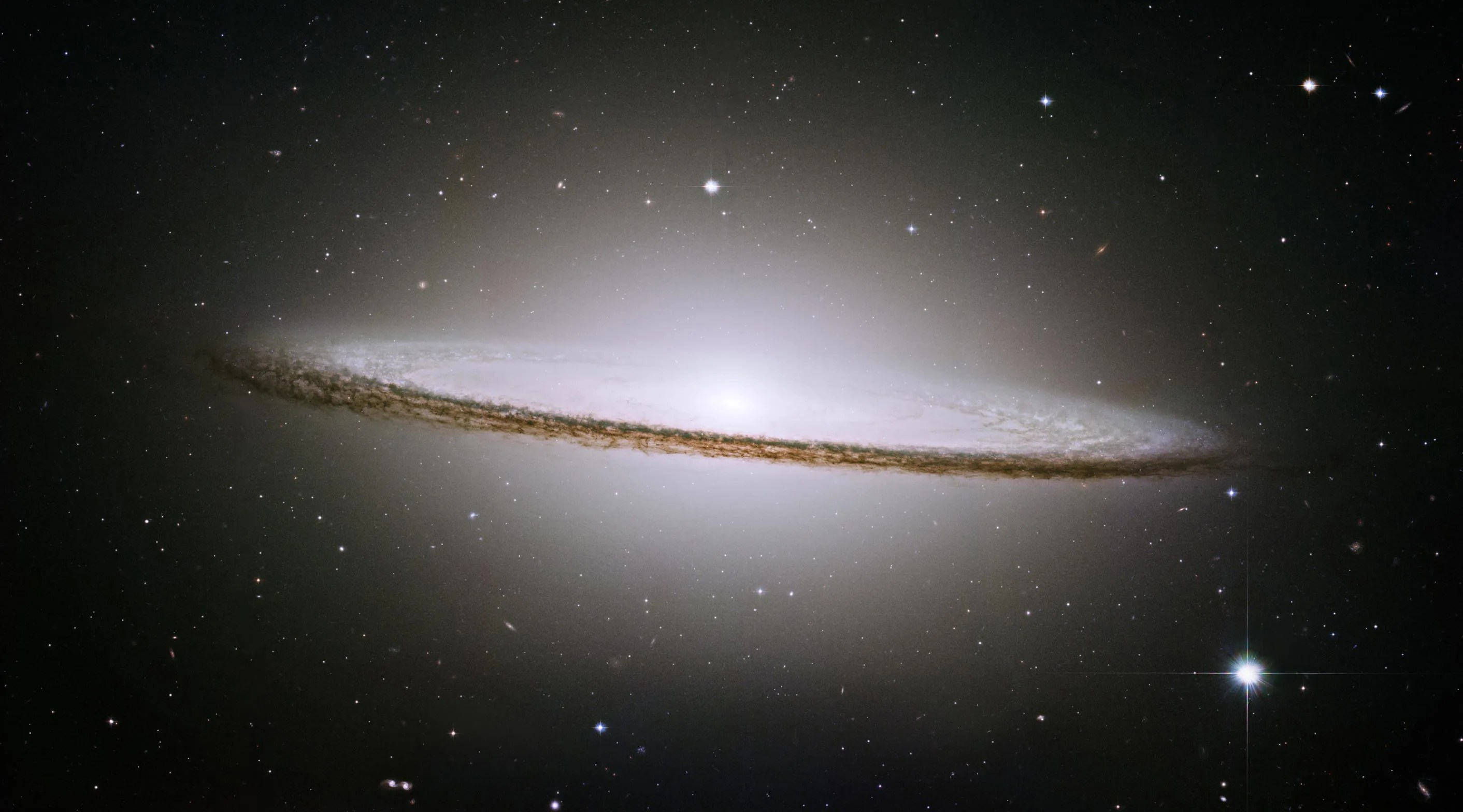
This stunning Hubble image of M104, better known as the Sombrero Galaxy, is one of the largest mosaics ever assembled from Hubble observations. The hallmark of the nearly edge-on galaxy is a brilliant, white, bulbous core encircled by thick dust lanes comprising the spiral structure of the galaxy. This dust lane is the site of star formation in the galaxy.
Hubble easily resolves the Sombrero Galaxy’s rich system of globular clusters, estimated to be nearly 2,000 in number — 10 times more than the number of globular clusters in our Milky Way Galaxy. The ages of the clusters are similar to those in the Milky Way, ranging from 10-13 billion years old. Embedded in the bright core of M104 is a smaller disk (not visible in the image), which is tilted relative to the large disk. X-ray emission suggests that there is material falling into the compact core, where a massive black hole resides.
With an apparent magnitude of 8, the Sombrero Galaxy is beyond the limit of naked-eye visibility but can be spotted through small telescopes most easily during May. M104 is located 28 million light-years away in the constellation Virgo, and with a mass equal to 800 billion suns, it is one of the most massive objects in the Virgo galaxy cluster.
M104 was discovered in 1781 by the French astronomer and comet hunter Pierre Méchain, one of Charles Messier’s colleagues.


Comments
Post a Comment