Corusant.....capital of the galaxy, a sith lord is in charge of the imperial senate, my dad, here in USA, NYC, to Corusant, Rev of the Sith..Star Wars 1.......Phantom M.......my dad, and me, Annakin Sky..
The architects who built the Jazz Age really knew how to get down. In January 1931, they turned the city’s annual Beaux Arts Ball into the ultimate Gatsby-approved bash. Instead of the stuffy historicism of years past, the party’s theme was “Fête Moderne — a Fantasie in Flame and Silver.” Advance advertising for the Ball in the New York Times promised an event “modernistic, futuristic, cubistic, altruistic, mystic, architistic and feministic,” featuring the city’s most renowned architects dressed as their buildings, celebrating both themselves and the modern fantasy metropolis they had forged in flame and silver. Art Deco New York: the skyscraper city, glittering and strong, reaching ever higher – through technological advancement and American ingenuity – toward excitement, prosperity, enlightenment, and power.
And so, the fabulous photo: William Van Alen, resplendent as his Chrysler Building, flanked from left to right by Stewart Walker (The Fuller Building), Leonard Schultze (The Waldorf-Astoria), Ely Jacques Kahn (The Squibb Building), Ralph Walker (1 Wall Street), D.E.Ward (The Metropolitan Tower), and Joseph H. Freelander (The Museum of New York). The New York Times called this lineup, “a tableau vivant of the New York Skyline.” It is clearly not a serious photograph; it’s ebullient and celebratory because vivacious living was what Art Deco was all about: taking in a show at Radio City; shopping at Bloomingdales; dancing at the Rainbow Room. Lit up, steel-coated, and wrapped in mural and mosaic – here was New York, ascendant, turned out in all its finery.
Art Deco rendered the city spectacular because it exalted in modernity and the promise of the ever-replenishing future. Reveling in the new technology that allowed the first night-lighting for buildings, the English poet Alfred Noyes wrote of New York’s skyscrapers in 1926, “by night among their vast shafts of light and shadow, you see them towering up to crown themselves with stars. You seem to discover at last new dimensions at which some of the Cubists were aiming.” The Art Deco Style translated into the built environment the principles of Modern Art and more importantly brought that artistry to the public. Here was modern, machine-driven, social luxury on an unprecedented scale.
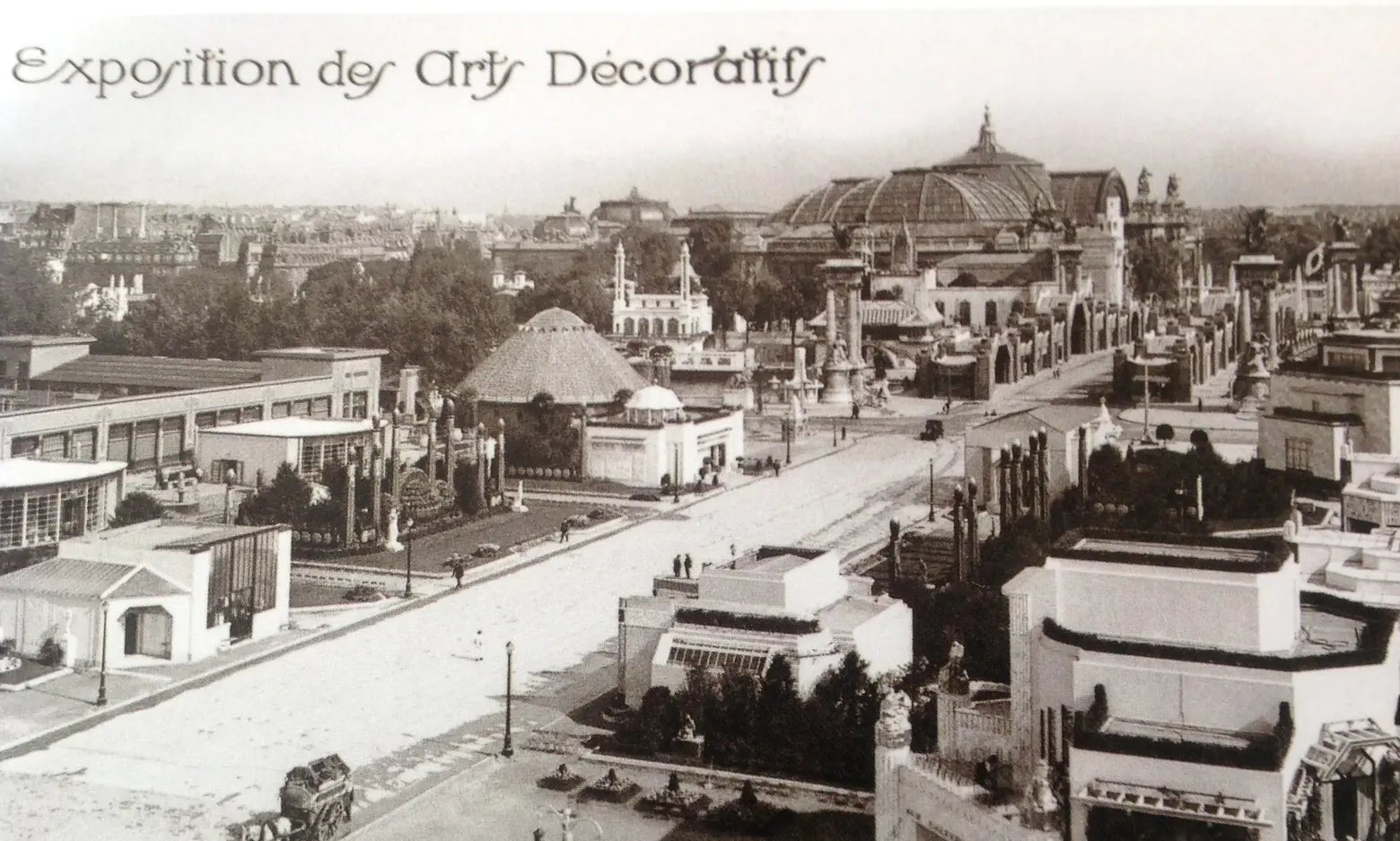 A 1925 postcard of the Exposition Internationale des Arts decoratifs et industriels modernes, via Wiki Commons
Since Art Deco was a modern style, it might seem contradictory that Art Deco architects would be gathered at the Beaux-Arts Ball, but most of them had been trained at the Ecole de Beaux Arts in Paris, the city where Art Deco originated. In the 1920s and ‘30s, the style was known variously as “Moderne,” “Modernistic” or “Jazz Modern.” The term “Art Deco” was developed by art and architecture historians in the 1960s to refer to work exhibited at the Exposition Internationale des Arts Decoratifs et Industriel Modernes in Paris in 1925.


Comments
Post a Comment